Prologue: Looking for the "Manual" in Life's Fog
On a rainy night in London, or during a frantic coffee break in New York or Seoul, we often feel like life is a tangled mess. That sense of helplessness usually stems from a simple fact: we are trying to assemble a highly complex instrument—our life—without the instruction manual.
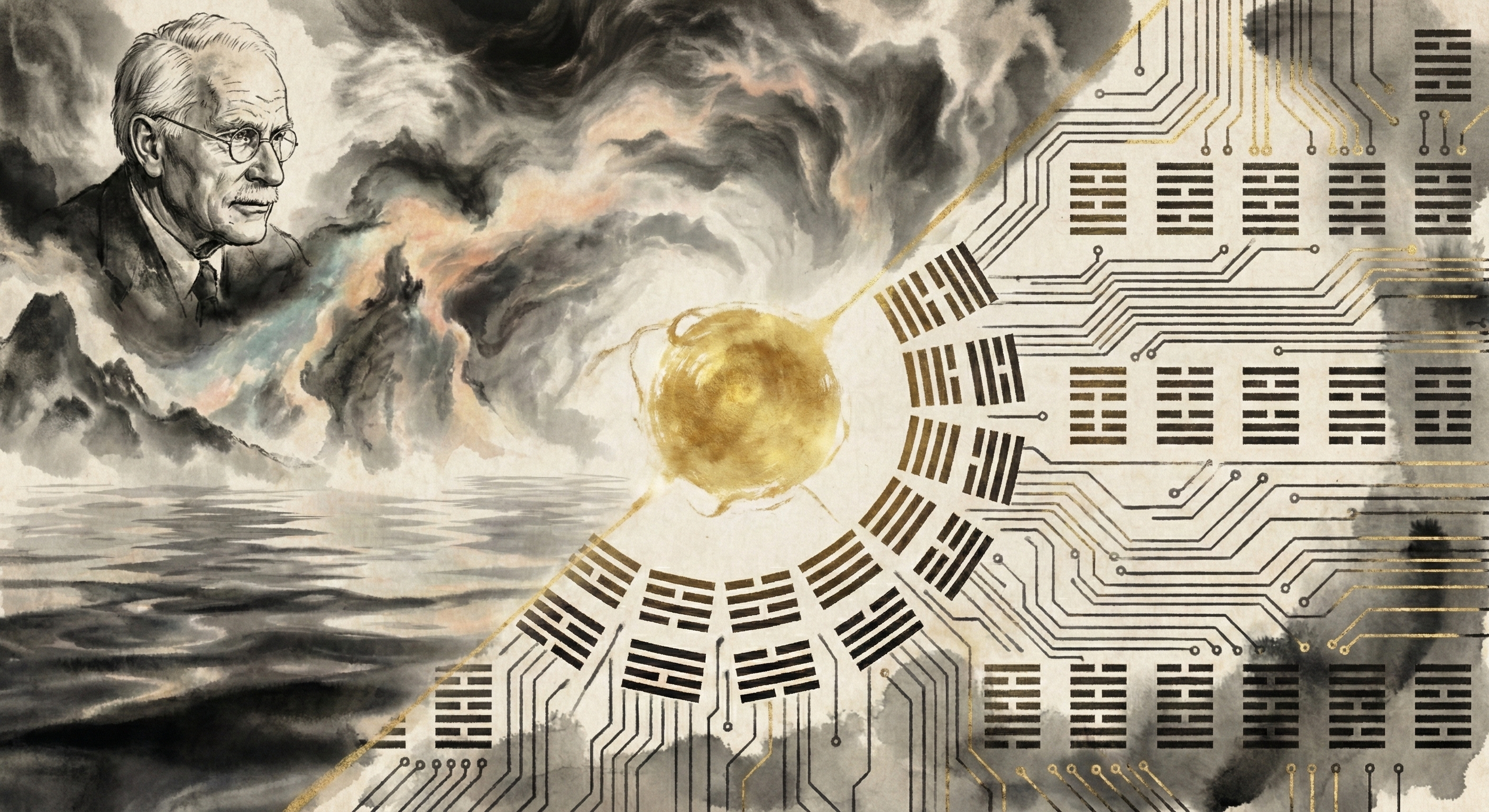
When logic fails us in the face of unpredictable change, we look for deeper patterns. In the 17th century, the mathematician G. W. Leibniz discovered a perfect binary system (0 and 1) in an ancient Chinese matrix. He realized this wasn't just philosophy; it was a pure mathematical modeling of the universe.
In the 20th century, the legendary psychologist Carl Jung took it a step further. In his preface to the I Ching, he introduced the concept of Synchronicity. To Jung, the I Ching was a mirror to the subconscious, helping us see the invisible, non-causal threads that connect seemingly random events.
What is the I Ching? (The 101)
For those new to it, think of the I Ching (The Book of Changes) as humanity’s earliest "Operating System."
Born over 3,000 years ago, it began as a set of dynamic laws observed from nature—the flow of water, the changing seasons, the shifting of mountains. It posits that the world is built on two fundamental forces: Yin and Yang. Much like the bits in a digital world, their combinations create 64 basic "state models" known as Hexagrams.
Beyond Mysticism: A Universal Manual for Transitions
At Yinsight, we believe the I Ching is not a book of prophecy, but a universal manual of states. It has been trusted by thinkers across cultures because it describes the objective stages of evolution and provides strategic advice for each.
- It doesn't predict an unchangeable fate; it describes the laws of a system.
- Whether it's a product's lifecycle or the ups and downs of a relationship, in the logic of the I Ching, these are simply "state codes" within a system.
State Modeling: Which "Code" Are You Running?
If we view life as a complex system, the 64 Hexagrams are preset State Codes. Most suffering comes from being "out of sync"—rushing when you should be still, or hesitating when you should leap.
1. The Incubation Phase (Hidden Dragon)
When energy is accumulating at the base level, forced action is often futile.
- Reality Check: The growing pains of a new career path, or the adjustment period in a foreign country.
- The Insight: This isn't about being passive; it's about deep rooting. Focus on input rather than output. Don't blame the flower for not blooming in winter; check the soil instead.
2. The Bottleneck (Stagnation but not Loss)
The feeling of being "stuck" is common in global careers. Jung noted that this stagnation is often the subconscious forcing you to stop and examine the shadows you’ve ignored.
- Reality Check: Working hard with no visible results, feeling isolated from the mainstream.
- The Insight: Obstacles are the whetstones of cognition. When the environment is restricted, your inner core must be firm. It’s a "stress test" for your growth.
3. The Pivot (The Changing Line)
Every Hexagram contains "Changing Lines"—the plot twists in a script, or that sudden "Rerouting" alert from your GPS when it detects a change in the road ahead.
- Reality Check: A chance coffee chat, or a tiny emotional shift noticed during a daily review.
- The Insight: Great pivots start from the minute. Perceive the ripples and flow with the momentum.
Becoming the "Insight-Seeker" of Your Life
The I Ching has endured because it touches a simple truth: Life is not a string of random noise; it is a game played with logic.
This is the vision of Yinsight. We don't suggest you look for prophecies from an unknown future. We suggest you identify the hidden fluctuations in your daily life through reflection and recording.
True composure doesn't come from having the script beforehand. It comes from having the "Manual" to recognize exactly which stage you are in. When the world transforms from a threatening fog into a game, you can navigate with grace, you’ve found your rhythm.
- Don't chase fate. Seek insight.*
